From Food Safety Plans to Reliable Practice: Building Operational Discipline at Every Shift
Published August 13, 2026
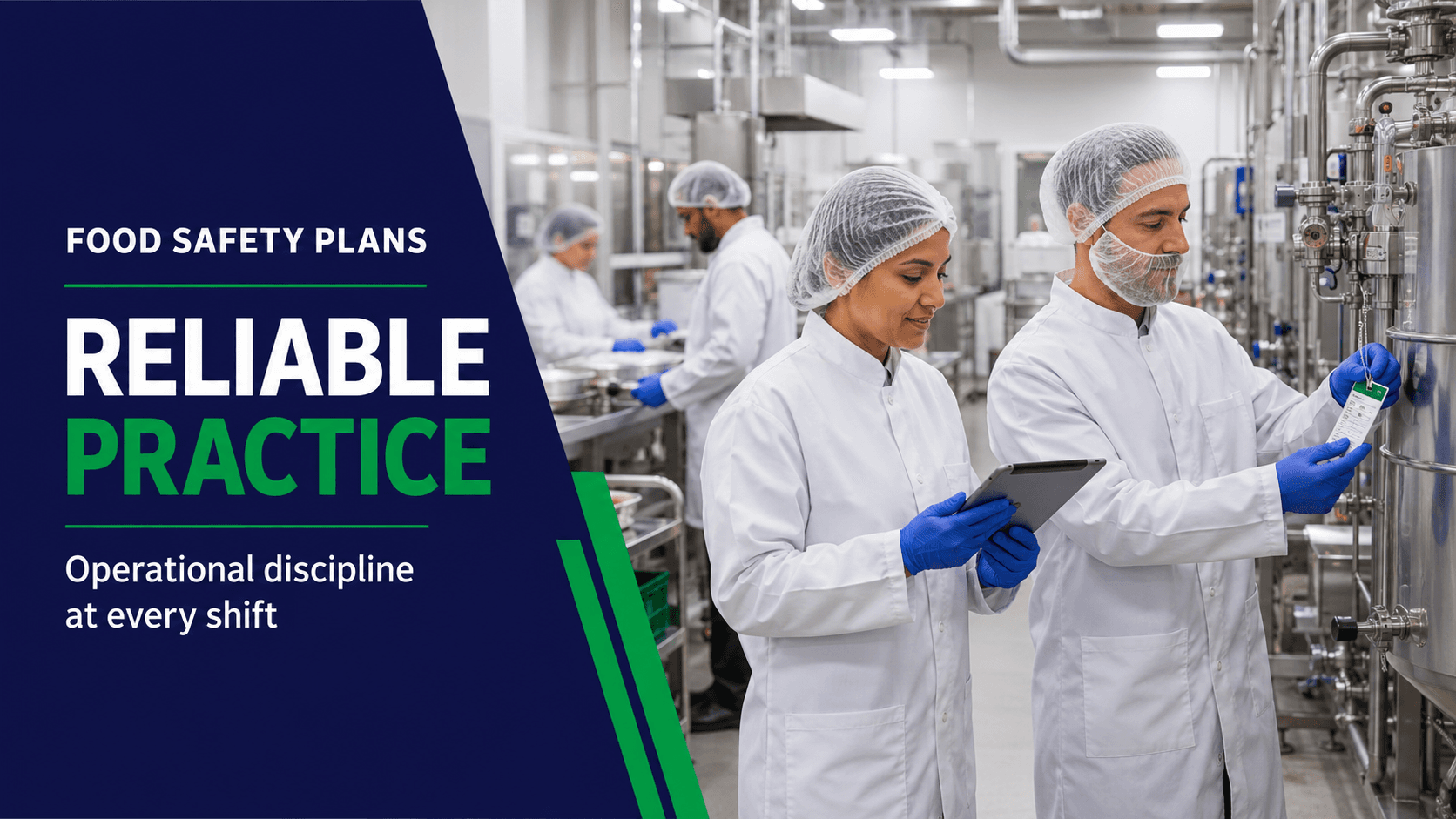
Food safety depends on more than documented procedures. Explore how clear ownership, effective handovers, practical monitoring, contractor controls, and disciplined verification turn a food safety management system into reliable daily practice.
From Food Safety Plans to Reliable Practice: Building Operational Discipline at Every Shift
A food safety management system can be technically sound and still produce inconsistent results. Procedures may be approved, hazards assessed, controls defined, and employees trained—yet gaps emerge during busy periods, shift changes, equipment failures, contractor transitions, or work at remote locations.
The missing element is often operational discipline: the consistent execution of required controls, even when conditions are difficult.
This matters across hotels, hospitals, corporate facilities, catering operations, labour accommodation, remote camps, and oil-and-gas sites. Wherever food is received, stored, prepared, transported, or served, food safety depends on people performing the right actions at the right time—and responding correctly when conditions fall outside expectations.
Why documented controls are not enough
A documented food safety plan explains what should happen. Operational discipline determines what actually happens.
Common weaknesses include:
- Monitoring records completed after the activity rather than at the required time
- Responsibilities that are understood differently across departments or shifts
- Corrective actions that address the immediate symptom without investigating the cause
- Informal handovers that omit unresolved food safety issues
- Contractor controls that are assumed rather than verified
- Repeated deviations that gradually become accepted as normal
- Training that explains the procedure but does not confirm practical competence
These gaps do not always result from a lack of effort. They may reflect complicated procedures, unclear authority, inadequate resources, poor communication, or control measures that do not fit actual operating conditions.
Strengthening food safety therefore requires attention to both system design and operational behaviour.
1. Make ownership visible at the point of work
Every important food safety control should have a clearly identified owner. General statements such as “the team is responsible” can create uncertainty, especially when several departments or contractors are involved.
For each control, define:
- Who performs the activity
- Who records or confirms the result
- Who reviews the record
- Who has authority to stop, reject, isolate, or escalate
- Who takes over during absence or shift change
Ownership should be visible in work instructions, shift plans, responsibility matrices, and handover records. Employees must also understand that accountability includes reporting deviations—not hiding or informally correcting them without traceability.
2. Translate hazard controls into practical routines
Hazard analysis may identify biological, chemical, physical, and allergen hazards, but frontline employees need practical instructions rather than technical language alone.
Each operational control should answer five questions:
- What must be controlled?
- What acceptable condition or limit applies?
- How and when will it be checked?
- What must happen if the requirement is not met?
- What evidence must be retained?
Instructions should reflect the actual workplace. A process that works in a central kitchen may not be suitable for a remote catering unit with different equipment, staffing, transport times, or storage capacity.
Before implementation, involve the people who perform the work. They can identify impractical steps, ambiguous language, and differences between the documented process and real operating conditions.
3. Design monitoring that supports decisions
Monitoring is not merely recordkeeping. Its purpose is to determine whether a process remains under control and whether action is required.
Effective monitoring arrangements specify the method, frequency, equipment, responsibility, and response to an unacceptable result. Monitoring forms should be simple enough to use during operations while still providing meaningful evidence.
Warning signs of weak monitoring include identical entries across long periods, missing times or signatures, unexplained corrections, and records completed in batches. Supervisors should not only check whether a form is complete; they should compare records with actual conditions and ask employees to explain what they would do after a deviation.
Digital tools can improve visibility and escalation, but technology cannot compensate for unclear requirements or weak supervision. Whether records are paper-based or electronic, they must support timely decisions.
4. Treat shift handovers as a food safety control
Many operational failures occur between activities rather than during them. Shift changes, maintenance work, cleaning schedules, delivery delays, and contractor interfaces can all interrupt control.
A disciplined handover should communicate:
- Products on hold or awaiting a decision
- Temperature, storage, sanitation, or equipment concerns
- Incomplete corrective actions
- Changes to menus, ingredients, or allergen information
- Supplier or delivery issues
- Pest-control observations
- Equipment released after maintenance
- Tasks requiring follow-up during the next shift
Important issues should be recorded, assigned, and closed—not passed verbally without ownership. Incoming personnel should confirm their understanding, particularly where an unresolved issue could affect product safety.
5. Create a clear response to abnormal conditions
Employees are more likely to act correctly when escalation rules are straightforward. Procedures should define what to do when refrigeration fails, monitoring equipment is unavailable, packaging is damaged, contamination is suspected, cleaning is incomplete, or an ingredient cannot be verified.
A practical response sequence is:
- Stop or contain the affected activity.
- Identify and isolate potentially affected food.
- Notify the authorized person.
- Assess the situation using approved criteria.
- Record the decision and action taken.
- Investigate the cause where appropriate.
- Verify that control has been restored before normal work resumes.
Employees must know they will be supported when they stop an activity for a genuine food safety concern. If production pressure routinely overrides escalation, the written system will lose credibility.
6. Control contractor and supplier interfaces
Service and oil-and-gas organizations often depend on caterers, transport providers, cleaning contractors, pest-management companies, maintenance teams, and ingredient suppliers. Responsibilities can become fragmented at these interfaces.
Contracts and service agreements should define relevant food safety expectations, reporting requirements, access controls, competence needs, emergency arrangements, and required records. However, contractual language alone is insufficient.
Organizations should verify implementation through proportionate activities such as receiving checks, performance reviews, inspections, record sampling, and follow-up of nonconformities. Changes in suppliers, personnel, ingredients, transport routes, or service scope should trigger a review of associated risks and controls.
7. Separate correction, corrective action, and verification
When a deviation occurs, three different activities may be needed:
- Correction: dealing with the immediate problem, such as isolating affected food
- Corrective action: addressing the cause to prevent recurrence
- Verification: confirming that the control system and actions are working as intended
Confusing these activities can allow recurring problems to continue. Replacing a damaged seal, for example, corrects the immediate issue. Understanding why inspections failed to detect deterioration may require corrective action. A later inspection or trend review can then verify effectiveness.
Verification should include direct observation, record review, internal audits, equipment checks, trend analysis, and confirmation that corrective actions remain effective. The objective is not to generate more paperwork; it is to establish confidence that controls work consistently.
A practical 30-day discipline reset
Organizations seeking a focused improvement can begin with a short operational review:
- Select one food process with meaningful risk or recurring deviations.
- Walk through it during normal operations and at a shift change.
- Compare actual practice with the approved procedure.
- Ask employees to explain limits, monitoring, and escalation steps.
- Review recent records for completeness, timing, and credible variation.
- Examine open actions and repeated findings.
- Simplify unclear instructions and assign missing responsibilities.
- Observe the process again to confirm improvement.
This approach can reveal system weaknesses without launching an unnecessarily broad initiative. Lessons can then be applied to other processes.
Conclusion
Reliable food safety is created through disciplined daily execution. Clear ownership, practical controls, timely monitoring, effective handovers, confident escalation, managed contractor interfaces, and meaningful verification help turn a documented system into consistent performance.
Quality Track supports organizations in Saudi Arabia and the UAE with food safety management systems, operational assessments, auditing, and professional training. If your organization wants to strengthen the connection between documented requirements and frontline practice, a focused review can provide a practical starting point.